
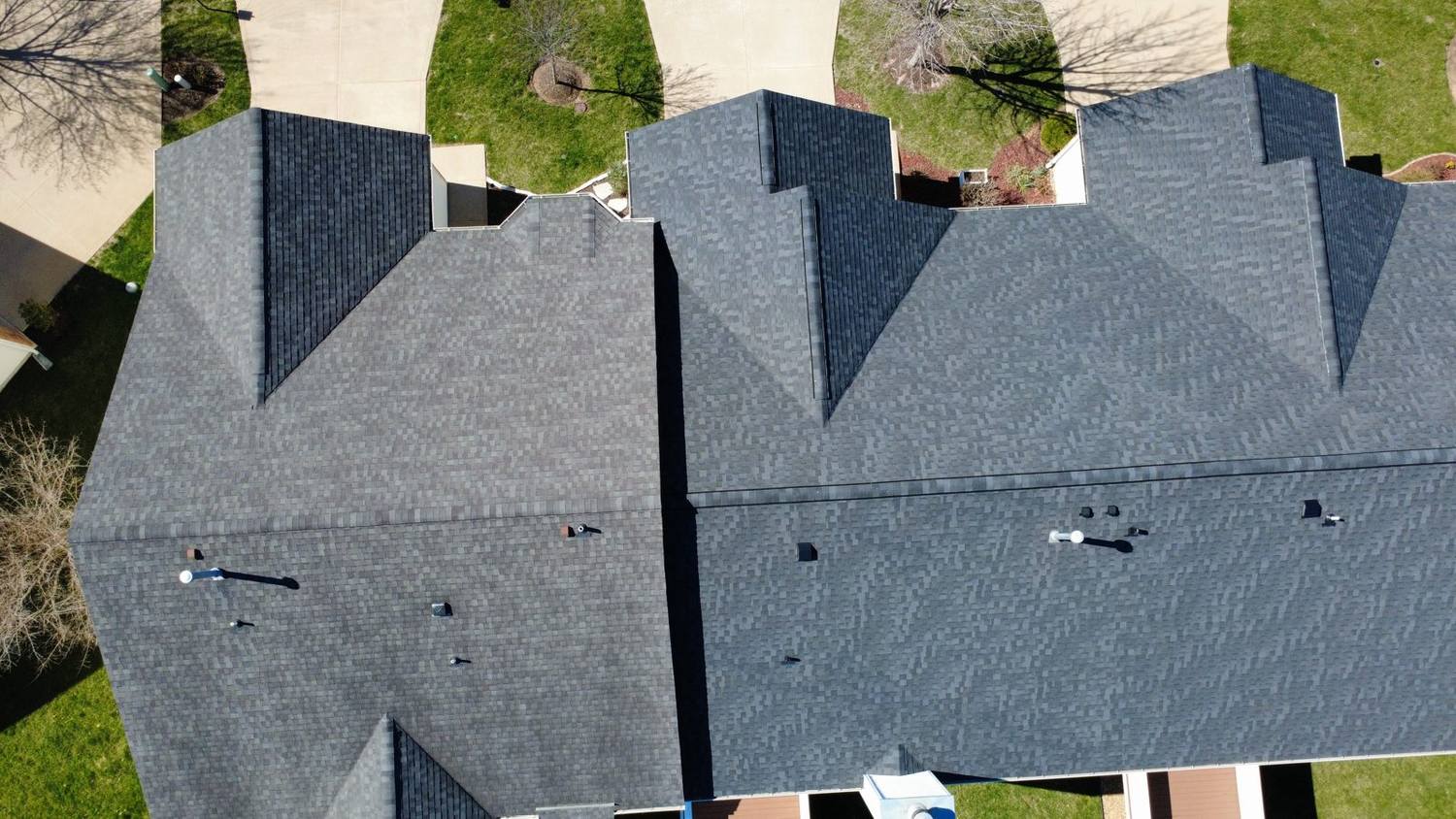
Flat and Low-Slope Roof Repair in Franklin County, MO
A flat roof is never truly flat. A porch roof, a room addition off the back of a Union ranch, or the membrane on a Washington storefront is built with a slight pitch so water runs to a drain or an edge. When that slope fails, or the membrane seams open up, water stops moving and starts working. This guide covers what actually goes wrong on low-slope roofs here, how to tell a harmless puddle from a leak in the making, and the repairs that hold.
Emmendorfer Exteriors has worked low-slope and flat sections across Franklin County since 1990, from back-porch additions in Pacific to commercial buildings in Sullivan and New Haven. The same in-house family crew that handles steep shingle work handles your membrane, so the flashing where your flat addition meets the main house is detailed by people who do both for a living, not a subcontractor who only knows one.
When ponding water is cosmetic and when it is a real problem
After a hard Missouri rain, almost every flat roof holds a little water. The honest rule of thumb roofers use is the 48-hour test. If a puddle drains or evaporates within a day or two of the rain stopping, it is usually cosmetic and not hurting anything. Membrane is built to take occasional water. A shallow film that comes and goes with the weather is normal on a low-slope roof and not a reason to panic.
Ponding becomes a real problem when the water never leaves. Standing water that is still there days after the rain, or that leaves a permanent dark ring of dirt and algae, means your slope or your drainage has failed. That trapped water adds weight, freezes and thaws through a Franklin County winter, and slowly degrades the membrane and the seams right where it sits. Over time it finds the deck.
The fastest way to read your own roof is from inside. A ceiling stain on a porch, a bubble in the addition drywall, or a musty smell after rain means water is already getting through. At that point the puddle on top is not cosmetic anymore. That is the roof telling you a seam or a flashing detail has opened, and it is worth getting eyes on before the deck underneath goes soft.
How TPO and EPDM membranes fail, and how each gets repaired
Most low-slope roofs in this area use one of two single-ply membranes. TPO is the white sheet you see on a lot of newer additions and commercial buildings, welded together with hot air at the seams. EPDM is the black rubber membrane, common on older flat roofs, glued or taped at the seams. Both are good systems. They fail in different ways, and the repair has to match the material or it will not last a season.
TPO fails at the welds. A seam that was not welded hot enough, or that has aged and gone brittle, opens a hairline channel that water tracks straight into. The right fix is to clean the area and heat-weld a new TPO patch over it so the repair becomes one continuous sheet. A smear of caulk over a TPO seam is a temporary patch that peels in the next freeze, not a real repair.
EPDM usually fails where the seam tape lets go or where the rubber shrinks and pulls at a corner or a curb. The fix is to scrub the membrane, prime it, and bond a fresh EPDM cover strip over the opened seam so the bond is chemical, not just stuck on top. We match the repair to whatever membrane is already up there, because a TPO patch on EPDM, or the wrong adhesive, simply will not hold.
Seam failures, flashings, and the spots that leak first
On a flat roof the field of the membrane rarely leaks. The trouble is almost always at a transition. The seams between sheets, the flashing where the roof turns up a wall, the boot around a vent pipe, and the edge metal at the perimeter are where nearly every low-slope leak in Franklin County starts. Water finds the one detail that was rushed and works it.
The wall flashing is the classic offender on a porch or an addition. Where your low-slope roof butts into the main house, the membrane has to run up the wall and tuck behind the siding or into a counterflashing. When that termination is short, loose, or never sealed right, rain blows in behind it and runs down inside the wall, often showing up several feet away from the actual entry point.
Pipe boots and curbs around skylights or HVAC units are the other usual suspects, especially on commercial roofs in Washington and Union. The pre-formed boot cracks, or the sealant at a curb dries out and splits. These are targeted repairs when caught early. Left alone, one bad boot can soak a wide section of deck and turn a small fix into a tear-off.
Drainage is the real fix for chronic ponding
Patching a membrane stops a leak. It does not stop water from pooling in the same low spot every rain. If your flat roof ponds in the same place no matter what, the underlying issue is drainage, and that is what has to be solved or the puddle keeps eating the same patch. The water has to be given somewhere to go.
On most Franklin County flat roofs that means keeping the existing path clear and correcting the slope toward it. Clogged internal drains, leaf-packed scuppers, and gutters that no longer pitch are the most common causes of standing water we find. Sometimes the answer is as simple as cleaning a blocked drain. Other times a low spot needs tapered insulation built up under a new membrane to create real slope.
This is also where a flat roof ties into the rest of the exterior. Water coming off a low-slope addition has to reach a gutter that actually carries it away from the foundation. We look at the whole path, roof to drain to gutter to ground, because a perfect membrane patch over a drainage problem just moves the puddle a few feet. Fixing drainage is what makes the repair permanent.
Porches, additions, and commercial buildings each behave differently
A small back-porch roof and a big commercial membrane have the same physics but different stakes. On a porch or a sunroom addition, the low-slope section is small and the leak usually shows up fast as a ceiling stain inside the house, so repairs are quick and cheap when you catch them. The risk is ignoring a small puddle until it rots the porch deck and the framing.
Room additions are where we see the most hidden trouble in Franklin County homes. The seam where the original house meets the addition was built by two different crews at two different times, and that joint is where water sneaks in. We pay special attention to that transition flashing because it is the single most common failure point on an added-on low-slope roof.
Commercial buildings in Union, Washington, Sullivan, and New Haven carry the biggest membranes and the most rooftop equipment, which means more curbs, more pipe penetrations, and more seams to keep watertight. A scheduled look at the seams and flashings before each storm season is far cheaper than an interior repair after water reaches inventory or a tenant space. Our crew handles those the same way we handle a residential porch, in-house and detailed.
Storm damage, insurance, and what we leave behind
Eastern Missouri hail and straight-line wind hit flat roofs differently than steep ones. Hail bruises a single-ply membrane and can split aging seams, and high wind lifts loose edge metal and peels back termination bars. The damage is real but harder for an untrained eye to see than a missing shingle, which is why a proper inspection matters after a Franklin County storm.
When storm damage is the cause, it is often a covered claim. Tom Emmendorfer documents the membrane and seam damage, files the claim, and meets your insurance adjuster on the roof from start to finish, so the approved scope reflects what the storm actually did to the flat section, not a guess from the ground. That on-roof meeting is how flat-roof damage gets fairly accounted for instead of underpaid.
However we leave your roof, we clean up like it is our own. Every job site gets magnet-swept for nails and fasteners before the crew leaves, on a commercial lot in Washington the same as a back porch in Union. You should not be finding hardware in your driveway or your landscaping after a repair, and with our family crews you will not.
Flat Roof Repair: common questions
Standing water or a stain on your flat roof? Get it looked at
A real Emmendorfer climbs your low-slope roof, checks the seams, flashings, and drainage, and gives you a straight written estimate. Free across Franklin County. Call (314) 568-4163.
- We walk your actual roof before we quote it
- The manufacturer is named on your written estimate
- The price you approve is the price you pay
- Tom handles your insurance claim start to finish